

El reloj de la catedral de Lima[1] acababa de dar las siete. Aunque no era muy tarde, las calles de la ciudad ya estaban envueltas en las sombras de la noche. Era una noche oscura. El viento, lanzando gritos, cogía el polvo de las calles y lo arrojaba al aire. Arriba unas nubes negrísimas corrían rápidamente a través del cielo.
Manuel Ramón echó una mirada hacia atrás y se dió prisa para llegar pronto a la bien iluminada Plaza de Armas.[2]
“¡Vaya una noche!” exclamó. “Hasta los perros se quedan en casa.”
Sus propias palabras, pronunciadas en voz baja, le animaron un poco y repitió en voz alta:
“Si, hasta los perros se quedan en casa… Y ¿por qué salgo yo? ¡Ah! Porque ese norteAmérica no, ese señor Grant, me manda llevar esto a su amigo Pablo González. ¿Será[3] cosa de gran Valor? ¡Bah! Seguramente que no. No valdrá un sol.”[4]
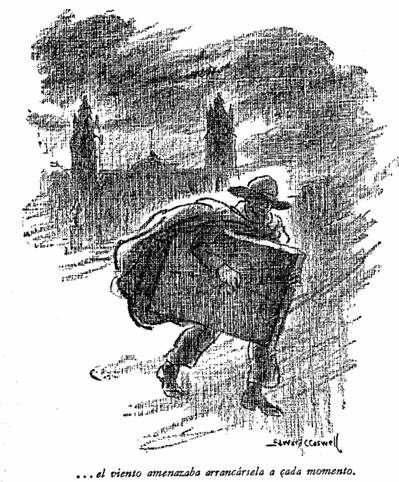
Manuel se dejaba arrastrar por el viento como por la corriente de un río. Bajo el brazo llevaba una caja envuelta en papel verde. Aunque no pesaba mucho, era bastante grande. Tenía casi tres pies de largo y más de dos pies de ancho. Los brazos de Manuel eran bastante cortos y le era difícil tenerla. Al atravesar la Plaza de Armas el viento amenazaba arrancársela a cada momento.
“¡Demonio! Si la caja se me escapa, se hace pedazos,”[5] dijo Manuel. Y añadió en seguida: “¿Qué habrá aquí dentro?”
La curiosidad le picaba al muchacho, pero no se atrevió a abrir la caja.
Al dejar la plaza y entrar en una calle estrecha, echó otra mirada hacia atrás. La Plaza de Armas estaba completamente abandonada. En una noche tan fea, todos los vecinos de la ciudad de Lima, menos Manuel, se quedaban en casa. Por lo menos, así le parecía al muchacho. Este pensamiento le llenó de tristeza. Sintió la necesidad de tomar un vaso de vino, de hablar con sus compañeros, pero le había prometido al señor Grant entregar la caja a Pablo González, y se la entregaría. Siempre había sido un criado fiel.
No, no debía detenerse en ninguna parte. Sin embargo, no sería gran pecado entrar en aquel café al otro lado de la calle a tomar un vasito. Uno, uno nada más. Tal vez encontraría allí algún amigo.
[1] Lima is the capital of Peru, fourth both in size and in population among the ten independent nations of South America. Peru lies on the Pacific coast between Ecuador on the north and Chile on the south. The country has an area somewhat larger than that of Texas and California combined, and a population approximately the same as that of New York City. Its culture is the oldest in South America, dating from many centuries before the Spanish invasion. Lima has a population of 450,000.
[2] The Plaza de Armas was the center about which the colonial city of Lima grew up in the days of the Conquistadores. The Governor’s Palace extends across the entire north side of the Plaza, and the Cathedral of Lima is on the east. Francisco Pizarro, the conqueror of Peru, laid the first stone of the cathedral with his own hands the day the city of Lima was founded, January 18, 1535. A body, said to be that of Pizarro, lies in a glass case in the cathedral.
[3] Será… I wonder if it is… The future and future perfect are often used in Spanish to express conjecture or probability. Watch for other examples.
[4] No valdrá un sol, It probably isn’t worth a sol. A Peruvian sol had a value of about $.16 in 1941. There are 100 centavos in a sol, and ten soles make a pound. Prices are written: Lp. 1.8.25, that is, 1 (Peruvian) pound, 8 soles, 25 centavos.
[5] se hace pedazos, it will smash (break in pieces). The present tense is often used instead of the future for vividness.
Exercises
A. Memorize.
- acabar de (+inf.) – to have just
- al atravesar – on crossing
- a través de – across
- darse prisa – to hurry
- en casa – at home, indoors
- en ninguna parte – nowhere, anywhere
- en voz alta – aloud
- hacer(se) pedazos – to smash
- hacia atrás – backwards
- por lo menos – at least
- sin embargo – nevertheless, however
- tener tres pies de largo (ancho) – to be three feet long (wide)
B. Review all tenses of the following irregular verbs.
dar
estar
salir
decir
haber
ser
detener
hacer
valer
C. Translate.
- The cathedral clock has just struck seven.
- Nevertheless, the city is already enveloped in the shadows of the night.
- Black clouds are racing across the sky.
- It is such an ugly night that even the dogs stay indoors.
- Emmanuel is carrying a box under his arm.
- Although it is a large box, it doesn’t weigh much.
- It probably isn’t of great value.
- Emmanuel has promised to deliver it to Pablo González.
- "If I don’t hurry," says Emmanuel in a low voice, "Mr. González will not be at home."
- The Street is not very well lighted.
- Emmanuel looks back (casts a glance backward) and exclaims: "My, what a night!"
- The wind threatens to tear the box from him.
- If it gets away from him, it will smash.
- In that café on the other side of the street he would be able to drink a glass of wine.
- But Emmanuel doesn’t dare to stop anywhere.


Click to See or Add Your Own »
gracias!
can you please post all the chapters? this is so helpful for spanish class and i dont know how to get text online No problem if u cannot but thanks anyways
sorry nevermind realized they are all here
gracias……………………….
pueden por favor poner el libro completo? MUCHAS GRACIAS!
El libro completo sí está aquí. Quieres decir una copia para bajar? Si quieres eso mandame un mensaje y puedo enviartelo por correo (en PDF).
Me gustaría tener el libro completo en PDF… Puedes enviármelo por favor!!!
Acabo de mandartelo. Que lo disfrutes!
thanks so much for this!! could you also send me the complete novel in pdf? i would really appreciate it.
No sé si todavía lees este lugar/sitio, pero por favor, puedes mandarme una copia de este libro?
Could I please get a copy of the PDF for la noche oscura too?
Just sent it. Check your spam folder if you haven't received it.
Awesome! I have two copies of the book. I taught myself Spanish starting in 1981 when I was 34 years old. I worked through Spanish Made Simple and later the MLA Modern Spanish with reel to reel tapes. Una Noche Obscura en Lima was one of the best things I used to learn Spanish. I am delighted to see if available here for my Spanish students; and with all the exercises!
Glad to hear of someone else who found it as valuable as I did. I am also impressed you got your hands on two copies. By the way, I took a look at your site and just added a link to it. Your Spanish Grammar pdf and audio seems especially helpful.
Hello, I discovered this book and it is exactly what I need (spanish and english), could you send it in pdf ? Thanks
Just sent it. Check your spam folder if you haven’t received it.
Jeff,
Me gustaría recibir un PDF de esta novela clásica. La lei hace cuarenta anos y tengo ganas de volver a leerla otra vez. Gracias.
Acabo de enviartelo.
Hi! Thank you so much for sharing this book!! Could you please send it to me in pdf? Thanks in advance!
I just sent you an email.
Puedes mandarme la forma PDF del libro? Muchissimas gracias!
Claro. Ya lo he hecho.